LONDON.- Thaddaeus Ropac announced representation of the Leoncillo Foundation. Leoncillo Leonardi (1915–1968), known as Leoncillo, was one of the most important Italian sculptors of the post-war period, celebrated for transforming clay into a vehicle for the expressive ambitions of modern art. He forged an entirely new and, as art historian and curator Enrico Crispolti described, ‘unprecedented’ kind of sculpture, grounded in the poetics of the body and the gesture, and animated by a visceral, dynamic sense of materiality.
Artdaily Recommended · Paid Link
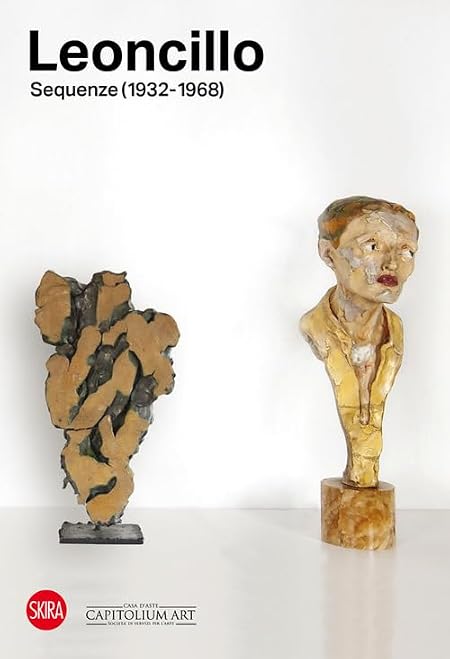
Leoncillo. Sequenze 1932-1968
A monograph on the Italian sculptor
Explore Leoncillo’s sculptures, ceramics, and expressive material experiments from 1932 to 1968.
See it on Amazon → As an Amazon Associate I earn from qualifying purchases.
Thaddaeus Ropac will work with the newly formed Leoncillo Foundation, and the inaugural exhibition of this collaboration will open in our Milan gallery in September 2026.
The Leoncillo Foundation was established with the purpose of safeguarding Leoncillo’s intellectual and artistic legacy, and to investigate the still-undiscovered aspects of one of the most significant artists of the post-war period. We look forward to partnering with Thaddaeus Ropac gallery to create new avenues for research and dialogue and foster broader scholarship, institutional collaboration and public awareness internationally. — Ariela Leonardi, President of Leoncillo Foundation
Leoncillo’s singular oeuvre garnered critical acclaim both within Italy and internationally over the course of his career – he notably represented his country in six editions of the Venice Biennale between 1948 and 1968. His work has since been the subject of solo exhibitions at institutions including Galleria Nazionale d’Arte Moderna, Rome (1979); Galleria d’Arte Moderna e Contemporanea, Palazzo Forti, Verona (1985); and Museo Novecento, Florence (2021). He has also featured in group exhibitions at Centre Pompidou, Paris (1986); Centro de Arte Reina Sofía, Madrid (1990); Solomon R. Guggenheim Museum, New York (1994); Galleria dell’Accademia, Florence (2012); Galleria Nazionale d’Arte Moderna e Contemporanea, Rome (2015, 2018); and Palazzo Strozzi, Florence (2018), among others.
Exhibiting Leoncillo’s work today is not merely an act of faith. It is a recognition of the beauty and inventiveness of a truly great artist. It is also a declaration that the present is illuminated by the light of the past. Finally, it is a revelation of a multifaceted artist, a joyful virtuoso who encapsulates the grace and spirituality of postwar Italian art. — Bernard Blistène, curator

Leoncillo’s work was never confined by a single style or movement. Material was his primary means of expression, through his unwavering devotion to clay. His sculptures are defined above all by their ability to reveal the medium’s intrinsic life force, to reflect the inner human experience. — Thaddaeus Ropac
While Leoncillo’s early work was predominantly figurative, reflecting an affinity with the expressive styles of the Baroque and the Scuola Romana, the Second World War precipitated a decisive shift in his practice towards increasingly experimental modes of abstraction. Deeply engaged with the existential possibilities of matter, he approached clay not merely as a sculptural medium but as a living substance that bore the potential of both destruction and renewal, often working directly with his hands or using wire to make deep incisions into the surface. ‘Cutting the clay with a wire is to enact a decisive gesture – cruel and liberating,’ Leoncillo stated. ‘The clay is like my own flesh, an absolute process of identification.’ His works conceive of sculpture as a process of continual becoming, rooted in the elemental forces of nature and the vital, transformative properties of clay.
Leoncillo stated, ‘I have always understood ceramics as a break with the traditional concept of sculpture.’ He embraced clay for its responsiveness to human touch and its capacity for immediate expression. For the artist, working with clay was in many ways an affirmation of the present.
I work the clay as if it were time: I shatter it, I reassemble it, I imbue it with the colour of wounded earth. Thus the sculpture becomes both memory and gesture. — Leoncillo







